

# Heliogabalus: The Worst Roman Emperor?
When people casually discuss The Worst Roman Emperors, a lot of attention is paid to their various depravities - Nero fiddling while Rome burned, Caligula sawing men in half, etc. I’m not interested in that kind of tier list. Roman emperors were a set of people who were pretty much uniformly rapists and genocedaires. Ancient authors only had an issue with it when the violence was directed at the upper class.
Heliogabalus, though, was straight up dogshit at politics. By the end of her reign she’d alienated every constituency that could have kept her in power and alive - including her own grandmother. Maybe this is for the best. Despite her own interpersonal violence, at least she wasn’t mass-murdering Scottish people like her cousin and uncle had.
Attacking and Dethroning God
Heliogabalus’ first confirmed kill came early in her reign, while she and her court were still en-route to Rome from Syria. Eutychianus was Soaemias’ boyfriend and Heliogabalus’ tutor and advisor - effectively her step-dad. He had been instrumental in winning the loyalty of the legions and engineering victory over Macrinus. There was talk of him and Soaemias getting married, in which case Heliogabalus would appoint him the royal heir.
That was, until Eutychianus tried to have a heart-to-heart with his step-kid. She had to tone it down. Her enthusiasm for Elagabal was off-putting. The Romans would view the cult as too foreign and not take her seriously. As the emperor, she needed to wisen up, and behave temperately… and stop having so much weird gay sex. Heliogabalus was enraged, and ordered her guard to kill Eutychianus. When they balked at the unhinged demand, she took a sword and stabbed him herself.
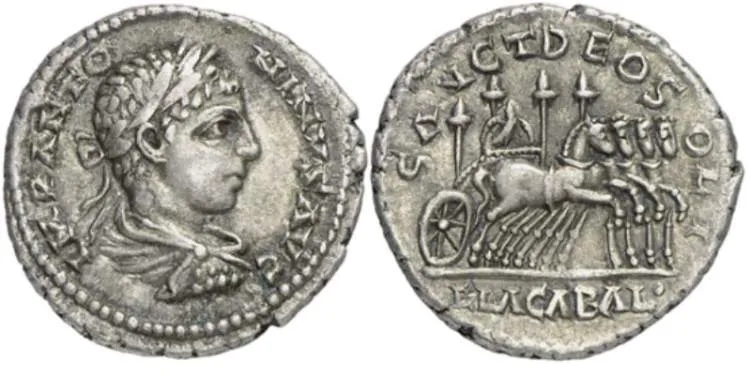
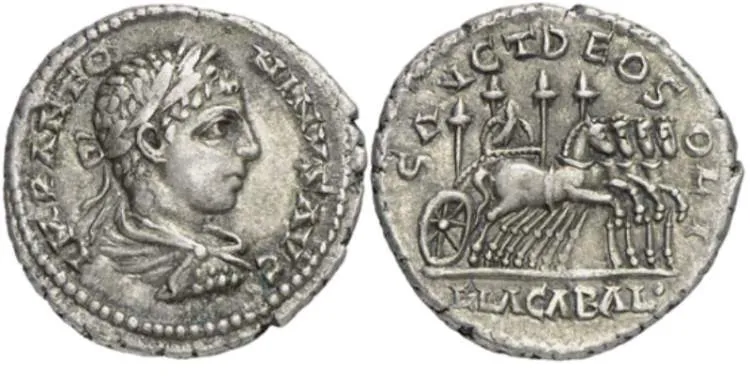
The priesthood of Elagabal was the most important thing in Heliogabalus’ life, and as such, she was bringing Elagabal to Rome with her so she could continue performing the rites for him every morning. She had Elagabal’s baetyl loaded onto a chariot and rolled him the entire way to Rome from Emesa. An artistic rendition of this journey was depicted on the coinage, so it must have been a big spectacle for the towns and cities the imperial party passed through.
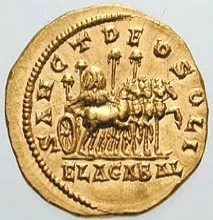
Heliogabalus paraded the baetyl through Rome. Then she began construction on the Elagabalium, a temple for the god, on the Palatine Hill, directly facing the Collosseum. This, in itself, was not too strange - the Romans loved yoinking the religious idols from conquered peoples and housing them in Rome to siphon off the divine favor. They’d brought the Lydian mother goddess Cybele back with them from their conquests in Anatolia, and she became incredibly popular (people even complained later that Heliogabalus was repressing Cybele’s cult with her own!). What actually shocked people was Heliogabalus’ decree that Elagabal would now be the chief god of the Roman pantheon.
Demoting Jupiter like that was a massive deal. He was the patron god of Rome like Elagabal was for Emesa - you couldn’t just stop worshipping him! He would get mad! The people of Rome were earnest believers in their religion and were incredibly worried that superseding Jupiter would piss him off and bring doom upon the city, if not the entire empire. On top of this, people viewed Elagabal as particularly foreign, and the cultural similarities between the Emesenes and other Semetic peoples (e.g. practicing circumcision and abstaining from pork) led to accusations of everything from magic to ritual cannibalism.
Heliogabalus continued performing the rites for Elagabal at dawn every single day, eschewing her responsibilities as emperor and oblivious to how pissed off this made everybody. Attendance at these ceremonies was mandatory for the senate and they did not enjoy this. Allegedly, somewhere in here Heliogabalus began identifying directly with Elagabal and claiming to be Elagabal incarnate (but they said this sort of thing about other “bad emperors” too).
As I mentioned already, Elagabal also made it onto the money, opposite the emperor’s face. The scarcity of these coins indicates a lack of buy-in ouside of a couple specific urban centers in the MENA region, but there were some people who were into it. Artifacts of Elagabal worship from this period have been found as far away as the modern Netherlands.
So, for a brief four year period in the third century, Rome was being forced to worship what they saw as a foreign, usurping god. Eutychianus had been right to be concerned. This was, if nothing else, an absolutely boneheaded political move, and could have gotten Heliogabalus killed all on its own. But wait, there’s more.
Debauchery
When Heliogabalus was not worshipping Elagabal, she was partying. She loved chariot racing, high-concept dinner parties, and weird sex, same as any other high-class Roman fail-child. This is where we get some of the most outrageous Heliogabalus stories. She, allegedly:
- appointed low-ranking men like prostitutes, athletes, and actors (ew, theater) to important political posts
- fell in love with a ex-slave charioteer and named him caesar
- had the praetorian guard search bathhouses for the biggest dicks in the empire
- threw livestock and slaves out of a building as gifts to whatever plebs could catch them
- drowned dinner guests in flower petals rigged to fall from the ceiling
- terrified dinner guests by releasing (secretly tame) lions and other scary beasts
- hosted a dinner where every guest had some kind of physical disability
- served her guests wax replicas of food while she ate real food
- served exotic or out of season food, or dishes with expensive but inedible ingredients like gemstones
- saved the places of honor next to her at dinners to, again, prostitutes, athletes, and actors
- forced high-class Romans to join her in drinking competitions
- engaged aging senators in lewd conversations about their sex lives
- harnessed naked women to a chariot and had them pull her around (also naked)
- presented as a woman and was the submissive partner in gay sex
- not only dressed in drag but asked if surgeons could give her a sex change
- worked as a prostitue, again in the feminine role, for fun, and opened a brothel at the palace
- only had male-female sex to practice playing the female role in bed
- allowed her mother and grandma to join senate meetings
The craziest of these stories come from the Historia Augusta, whose author loved making shit up. The drowning guests in flowers thing, for example, was probably adapted from a less-lethal story about emperor Nero. The “throwing livestock” out of a building bit is a deliberate obfuscation - what she actually threw (if this happened) were essentially blind boxes - tokens that could be exchanged for random gifts that could be candy, or a dead dog, or raw beef, or yes, enslaved people. That Soaemias and Maesa essentially joined the senate is sometimes construed as advocating for gender equality, but I think it’s more likely that this was a carveout for these particular women. They were the actual power behind the throne, so they used Heliogabalus to force their way into legitimate politics.
In general, these tall tales center Heliogabalus’ inversion of the social hierarchy in ways that humilitate the upper class - associating with undesirables, being penetrated during sex, allowing women to do politics, and just generally fucking around with senators who could not say no to the emperor. You might notice how many of these anecdotes are dinner-related, and that really speaks to the centrality of dinner parties in high-class Roman life. Nothing here about Heliogabalus mistreating normal people (except the poor chariot ladies). Not that any of this endeared Heliogabalus to the Roman public at large.
As you may know, the Romans did not share our modern notions of “straight” and “gay”. When it came to men having sex, the gender identity of who they had sex with did not reflect on their own identity at all - what was important was who was doing the penetrating. A man could penetrate all he wanted with no social consequence, but if he were penetrated just once, he “was considered unmanned and became an object of contempt […] there was no redemption […] the taint was permanent” (to quote Sidebottom (p.249)).
The socially acceptable way to have gay sex was to penetrate downwards on the social hierarchy: elite men could penetrate non-elite people of either gender, but not non-wife elite women, who were expected to be chaste or monogamous. Most easily, they could have sex with their slaves. This is part of the social dynamic that made freed slaves a permanent underclass - their masters had been allowed to penetrate them and that permanently devalued them as people. While this was all socially acceptable, it was still viewed as decadent, trashy, and “Greek”.
The idea that the emperor of all people, the apex of the social hierarchy, was “debasing” herself that way, was enough by itself for the Roman elite to declare her a degenerate. Doubly so because her prominent male partners were themselves ex-slaves who had been available for penetration. Then come the mean, mocking stories. I don’t want to claim that all of those sex stories were made up wholesale, though, because Heliogabalus’ weddings were a matter of public record.
Heliogabalus’ Six-to-Ten Weddings
Succession law in imperial Rome was absolutely fucked - at no point did they seem to establish any rules for who gets to be emperor when one died without an heir, and this caused so, so many problems over the centuries. Usually, an emperor would choose a successor themselves, and grant them the title of “caesar” which made them a sort of “vice-emperor” until the emperor died or abdicated, at which point the caesar would become the “augustus”, the primary emperor.
Usually the caesar was just the emperor’s firstborn son, if they had one. Heliogabalus, being fourteen, did not have one. As I already mentioned, the family’s initial plan was for Heliogabalus pick Eutychianus, her step-dad/tutor/advisor, but she stabbed him to death. So, it was time for Heliogabalus to start making babies. It was wife time.
Julia Cornelia Paula
Heliogabalus’ first wife was a nice girl named Paula, whom she married right after assuming the throne while en route to Rome. We don’t know much about her other than that she was “from the most aristocratic family in Rome”, whatever that means, and that she was around the same age as the emperor. The marriage lasted less then a year. Heliogabalus divorced her due to “a blemish on her body”. This was probably an arbitrary decision, made so that Heliogabalus could remarry someone she wanted. The person she wanted to marry seems almost engineered to piss off the most people possible.
Julia Aquilia Severa
Heliogabalus’ second wife was a Vestal Virgin. The Vestal Virgins were the six priestesses of the temple of Vesta, the Roman equivalent of the Greek goddess Hestia, the goddess of the hearth. They were in charge of making sure Vesta’s sacred fire never went out, housing various sacred objects, and doing ritual housekeeping to keep the Roman empire tidy. They were selected as children and held their roles for a minimum of thirty years, during which they enjoyed huge levels of privilege for women, as they were answerable only to the Pontifex Maximus, Rome’s high priest. They were essentially the symbolic, living embodiment of Rome. Also, as you can probably tell from the name, they took a vow of chastity.
Having sex with a Vestal was tantamount to fucking Rome itself, and the punishment was public torture and execution. For the Vestal, the punishment was being buried alive. This was incredibly serious stuff to the Romans. So, when Heliogabalus announced that she was marrying Aquilia, this was an extreme, extreme violation of social norms. But, the emperor was by convention the Pontifex Maximus, so the marriage procceeded.
The official justification for this marriage was that Heliogabalus wished for “godlike children” to be born from the union of a high-priest and a high-priestess. By marrying another diety-incarnate she could produce the Roman Kwizatsz Haderach, or something. However, this never happened, and in fact Heliogabalus never had any kids with any of her many wives. This kind of fascinates me in light of her profusion of weddings and known promiscuity.
Some Roman historians proposed that this wedding was a sham meant to provide a “semblance of virility” and that she only had sex with women to learn how to play the feminine part in sex with men. This just seems like them being mean, to me, but part of me does wonder if this was meant to be a lavender marriage. Perhaps Heliogabalus figured that if her wife had taken a vow of chastity then she would be exempt from needing to produce an heir. We don’t know what happened to Aquilia after Heliogabalus’ demise, so it’s possible that the Romans never actually punished her because she didn’t violate her vow of chastity at all.
The marriage to Aquilia led to public outrage, including among the army which was the base of the regime’s support. Heliogabalus was pressured into divorce by Soaemias and Maesa within the year.
Annia Aurelia Faustina
After being forced to end her demigod eugenics program, Heliogabalus chose her next wife out of pure spite. She set her sights on the wife of an aristocrat, had the husband executed on trumped up charges, and married the newly widowed Faustina. This marriage was also short-lived, but we don’t know why they broke up.
???
The historian Cassius Dio has Heliogabalus marrying two or three more unnamed women after her split with Faustina. It’s unclear how all this happened in such a short timeframe. In lieu of details, it’s time to cut over to the unnofficial spouses of Heliogabalus.
Hierocles
Hierocles was an Anatolian slave charioteer who Heliogabalus fell in love with at the races. She saw him get injured and took him back to the palace to tend to his wounds (and have sex). They got married with Heliogabalus in the role of the bride.
“Same-sex” marriages were not unknown in Rome, but they lacked legal authority. It was definitely weird for the emperor of all people to be bigamous - usually they’d just have concubines or mistresses, they could sleep with whoever they wanted. Heliogabalus clearly wanted Hierocles to be her actual, public spouse. Because this was not legally allowed, Heliogabalus tried to name Hierocles caesar, but Maesa shut her down. I can only imagine the emperor’s rage at finding her own solution to the succession problem only to have it ripped away from her.
Hierocles was an influential figure in Heliogabalus’ court - he’d get pride of place next to the emperor at dinners and his enslaved mother was brought to Rome and elevated to noble status. They stayed together for the balance of Heliogabalus’ reign, so it seems clear that Hierocles is who the emperor actually wanted to be with.
Zoticus
Allegedly, Heliogabalus enjoyed letting Hierocles catch her with other men so he would get jealous and beat her. This is another thing that seems like a smear, but there are definitely people who are into that sort of thing for real so, no comment. But one of those other men was a another freeman athlete named Zoticus. They never got married, but I’m giving him his own section anyway because its a fun story.
The emperor had dispatched the praetorians to scour the empire to find her the biggest penis in all the lands. This was extra scandalous because the Romans actually thought big penises were barbaric and irrational, while small penises were civilized and rational. Just a fun fact I had to get in there. Anyway, the praetorians brought back Zoticus. He and Heliogabalus spent the night together, and she was initially impressed by his huge penis. But then he was unable to actually get an erection. Enraged, Heliogabalus exiled him from Italy.
Athena & Urania
Not satisfied with her own weddings, Heliogabalus decided that Elagabal, the god, should get married. So, she transferred the symbols of Athena to the imperial palace and threw another massive imperial wedding. The idea was that the god of the sun ought to be married to a god of the moon, and that this would cement Elagabal’s place in the emperor’s revised Roman pantheon. Eventually, it was decided that Athena was too warlike, so Elagabal was remarried to the goddess Urania, and Urania’s religious objects were shipped in from Carthage.
For the Romans, this was definitely an abnormal thing to do. However, it did mean free food, drink, and games to mark the occasion. For the people in the provinces it was a different story. Each of the emperor’s marriage festivities were funded by supplemental taxes which were framed as “wedding gifts” from the public to the emperor. At least the people in Rome itself got to party - the people in Gaul not so much. They just had to pay up. Six to ten times in four years. While the upper crust hated Heliogabalus for her queerness, and the people of Rome hated her for violating their sacred traditions, people all throughout the provinces hated the emperor for the extreme degree of taxation she imposed upon them.
Julia Aquilia Severa (AGAIN!!!)
Near the end of her reign, Heliogabalus divorced her penultimate wife and remarried Aquilia the Vestal Virgin. I think this speaks to how primary reshaping Roman religion was to Heliogabalus, that she’d stubbornly return to this divine marriage idea after the pushback she’d gotten the first time. Given that Heliogabalus was assassinated and dragged through the street by a mob a short time later, it did not go better than the first time.
The End
By 222 CE, Maesa and Soaemias had to reckon with the fact that their puppet’s approval ratings were cratering out. To make matters worse, Heliogabalus still didn’t have an heir, partially because the candidates had been her step-dad she killed and her illegal husband everyone was homophobic about. To resolve this political crisis, Maesa convinced Heliogabalus to name her twelve-year-old cousin Severus Alexander caesar. By the time Heliogabalus realized this was the first step towards swapping out one grand-child for another, it had already been done.
In a panic, Heliogabalus tried to have Alexander assassinated. The attempt was botched, and it was very obvious who’d ordered it. Now spiralling, Heliogabalus just started publicly asserting that Alexander had, in fact, died. Back then you could just lie about stuff. But this was the last straw for the Praetorian Guard, who were in charge of protecting the imperial household, and they demanded Heliogabalus prove it. The whole extended family then went to the praetorians’ headquarters where the power struggle became very material very quickly. The praetorians, who had swords and access to where the imperial household slept, had the final say in who got to call themselves “emperor”.
Maesa and Alexander’s mother Mamea immediately entered ass-saving mode. If they needed to throw their own family under the bus to protect the dynasty, so be it. The night ended with Heliogabalus and Soaemias murdered by the praetorians as they tried to escape. Heliogabalus and Soaemias’ corpses were thrown to the angry mobs of Rome, who dismembered them and threw their body parts into the Tiber River. Back at the palace, the praetorians liquidated the members of Heliogabalus’ inner circle, including Hierocles and presumably Hierocles’ mom. The soldiers acclaimed Severus Alexander the new emperor, Maesa and Mamea at his side.
Severus Alexander (well, really, Maesa and Mamea - Alexander was twelve) quickly swept away all of Heliogabalus’ decrees. Heliogabalus’ memory was formally condemned. Now that everyone had learned what not to do from Heliogabalus’ example, Severus Alexander went on to rule rather competently, alongside Maesa and Mamea, for a good fifteen years.
Something to point out here is that the people with the actual reins on power did not change. Mamea and her daughters had been running the show in the background, and they continued to (well, RIP Soaemias) even into Severus Alexander’s adulthood. Given that Domna was calling the shots under Caracalla and had a large role under her husband Septimius Severus’ administration as well, the Severan Dynasty looks less like a series of male* rulers and more like rule by two sisters, whose male relatives acted as generals and figureheads.
By many metrics, the ladies did a pretty good job of it. Despite Heliogabalus being remembered as an S-tier “bad emperor”, the empire still existed by the time she was assassinated, which is more than, like, Honorius and the other late Western emperors could say, a couple of centuries later.
But maybe that’s damning with faint praise. On some level, the Emesans were merely propping up a house of cards that would eventually be collapsed by Severus Alexander’s own assassination. Septimius Severus’ famous deathbed advice of “be harmonious, enrich the soldiers, scorn all others” was not a sustainable way to run a state. As soon as Severus Alexander, Maesa, and Mamea ran out of money to enrich the soldiers with, the army overthrew them. Heliogabalus’ draining of the imperial treasury with all those weddings certainly only exacerbated this situation.
Heliogabalus’ Stolen Childhood
Below is a photo of me at the age of twelve or thirteen, standing in front of the same Pantheon in Rome that Heliogabalus would have.
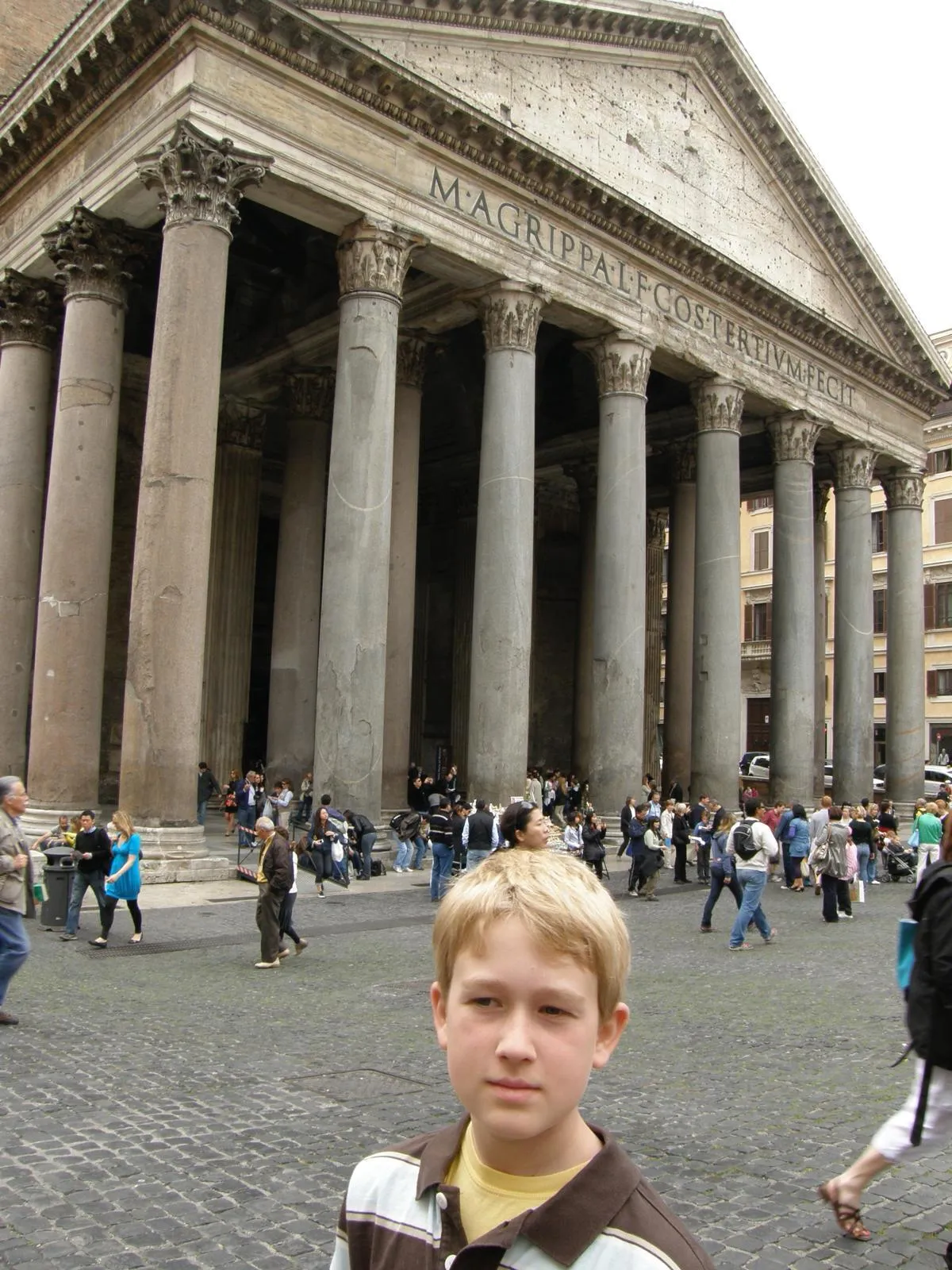
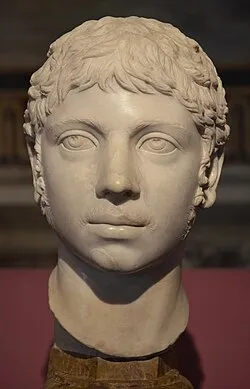
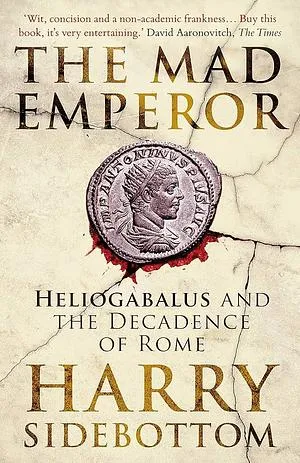
While reading The Mad Emperor, I couldn’t stop thinking about how Heliogabalus was literally a child for her entire reign. I kept trying to remember what I was like at that age. Look at the kid in that picture and tell me to my face he could rule the entire Mediterranean. It seems absurd. Compare to an actual, official bust from early in Heliogabalus’ reign. I don’t know about you, but that looks like a kid! And knowing the Romans, this was them trying to make her look as macho and herculean as possible.
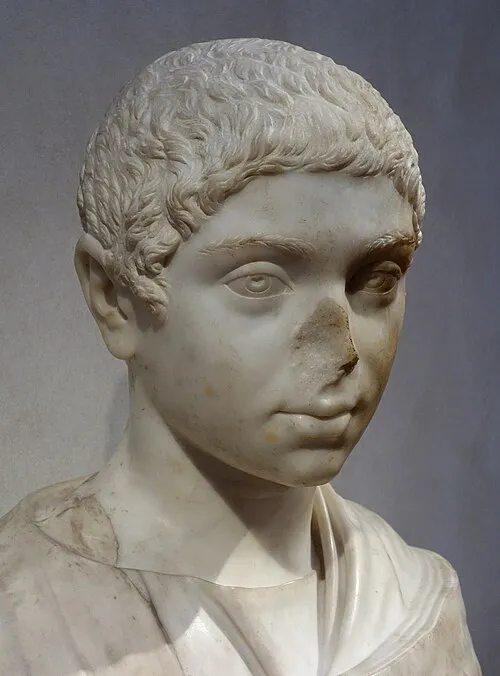
Of course, the Romans had much different ideas about childhood and adolescence than we do today. Legally speaking, you were a child and the personal property of your father until fourteen, at which point, poof, you’re an adult with adult responsibilities. Now, that doesn’t mean that they typically let fourteen year olds be the goddamn emperor. They didn’t have the concept of a “teenager”, but they still knew fourteen year olds weren’t suited to dealing with that much power and responsibility. So, sure, Heliogabalus was an “adult”, but come on.
Today you might need to be a certain age to vote, drive, drink alcohol, or join the army, but that has no bearing on puberty. There’s a biological factor here, and it’s a phase of growth tipified by poor impulse control, selfishness, and a heightened sex drive. Certainly Heliogabalus’ decisions are not those of someone with good impulse control. How was she supposed to grow out of selfishness when her every whim was law? And it’s super normal for teens to have low-stakes, high-intensity, shortlived romantic relationships. But a fifteen year old that claims they’re madly in love isn’t usually being pressured into marriage and children right then and there. That’s monarchy for you.
I think its pretty typical for a teenager, as part of figuring out who they want to be, to be stubborn and uncompromising. To say “this is who I am now, and you have to deal with it”, even if that identity changes month to month. So it seems obvious to me, that when given the reigns of power, Heliogabalus would use that opportunity to impose her will on reality. My god is the in charge now. Public religion is what I want it to be. My husband will be my legal spouse. You made me the emperor, grandma. Deal with it.
I would not have done one tenth the weird shit Heliogabalus did if I’d been emperor at fourteen, but I grew up in the twenty-first century, in a loving household, in a climate of historically abnormal peace and safety. Heliogabalus had no such luxuries. Her childhood was shaped by war and murder, her culture’s main entertainments were bloodsport, and mortality rates in ancient Rome were just way higher than they are today. On top of all that, she had to navigate questions of sexual and gender identity - something that makes people behave erratically even today! - in a society that’s even more rigid and patriarchal than ours.
Heliogabalus’ youth is something she had in common with other famously “bad” emperors. Nero assumed the throne at 17. Commodus at 19. Caracalla was 23. Caligula, 25. All older than Heliogabalus, sure, but still on the young end for Roman emperors. All grew up in the imperial court. It just makes you understand why the Founding Fathers set the minimum age for U.S. presidents at 35.
I find Heliogabalus to be a very tragic figure. At the end of the day, there’s no way for sure to know which tall tales about her are true and which are slander, but I think a lot of the crazier stuff makes sense when she’s understood as a traumatized, queer child, struggling with the weight of the entire known world thrust onto her shoulders. Of course she used her power to try to reshape the world into one that catered to her preferences. Some have called her insane, to which I would quote Robert Anton Wilson:
Under the present brutal and primitive conditions on this planet, every person you meet should be regarded as one of the walking wounded. We have never seen a man or woman not slightly deranged by either anxiety or grief. We have never seen a totally sane human being.
This isn’t at all to say that Heliogabalus did nothing wrong. But she basically had no chance.